
How Sociopathic Capitalism Came to Rule the World
Corporate executives haven't always believed that transactions must have winners and losers. But that’s not Donald J. Trump’s view.
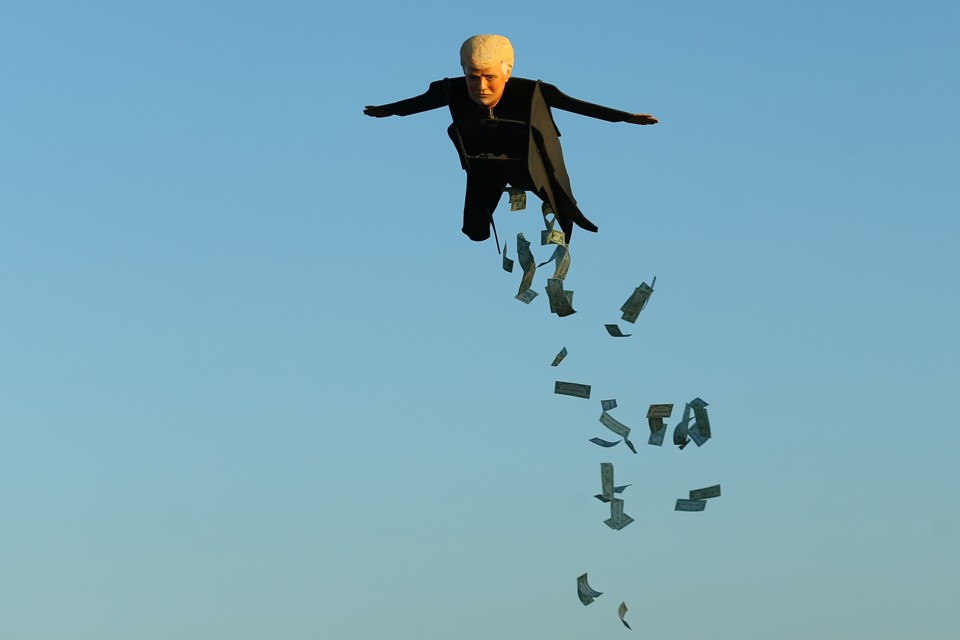
The stories we tell ourselves, far more than the evidence of scientific analysis, determine how we interpret the world around us. Accordingly, the fate of capitalism rests in no small measure on the real and imagined characters whose ethics and efforts, at any given time, seem to embody the system. Whether the system is identified with Bill Gates or Bernie Madoff, Horatio Alger or Gordon Gekko, opinions about how exactly capitalism works, no less than its moral fitness, reflect the heroes and villains who drive these tales.
Whichever of these two designations best describes Donald J. Trump, he is clearly a chief protagonist, the world over, in the contemporary tale of capitalism. This has been clear enough since at least the spring of this year, when the man known to millions around the world for the lurid catchphrase “You’re fired!†became the first political novice from the business world to become a major party nominee for president since Wendell Willkie in 1940.
Given that presidential campaigns require a candidate to endlessly descant on economic matters, rather than read between the lines of his behavior, people can look to Trump himself as his own best interpreter. “I beat people,†the candidate explained to Fox News’s Sean Hannity shortly after he announced that he was running for president last year. “I win.†Hannity had inquired into Trump’s credentials to be commander in chief, but he might just as well have asked him about his strategic mindset for business negotiations. “We don’t have victories anymore,†Trump declared in his announcement speech the day before. “We used to have victories, but we don’t have them. When was the last time anybody saw us beating, let’s say, China in a trade deal? They kill us.â€
Capitalism as zero-sum combat was certainly not the way many of the most prominent economists of the past half-century preferred to think about commercial exchange. In Capitalism and Freedom, the Nobel Prize-winner Milton Friedman assigned trade a central role in defending his vision of a highly complex society organized largely without the help of the visible hand of government. “The possibility of co-ordination through voluntary co-operation,†he wrote of this vision, “rests on the elementary—yet frequently denied—proposition that both parties to an economic transaction benefit from it, provided the transaction is bi-literally voluntary and informed.†Set aside for a moment the italicized clause as well as the qualifier “yet frequently deniedâ€â€”more on them later. For now, it is enough to point out that Friedman presents an ideal of commercial exchange that emphasizes not only a both-sides-win vision of trade but also the essentially civil nature of such engagement.
The civilizing effect of commerce has been a central argument on behalf of industrial development and liberal trade policies since at least the 18th century. “In times when industry and the arts flourish,†the Scottish philosopher David Hume wrote, “men are kept in perpetual occupation, and enjoy, as their reward, the occupation itself, as well as those pleasures which are the fruits of their labor.†Indeed, he continued, “[t]he more these refined arts advance, the more sociable men become,†with the result that “they must feel an encrease in humanity, from the very habit of conversing together, and contributing to each other’s pleasure and entertainment.â€
The 1754 essay from which these observations are drawn influenced Hume’s dear friend and fellow Scot Adam Smith as he organized the lectures that would later evolve into The Wealth of Nations. Among the many challenges Smith confronted in his attempt to establish the first principles of a new economic theory was how to square a system predicated on self-interest with the sociable demands of civilized society. His answer anticipates (and no doubt influenced) Friedman by stressing the inherently cooperative nature of commercial exchange.
In the unusually lyrical passage that concludes the opening chapter of The Wealth of Nations, Smith celebrates the “joint labour†that is required to meet even the most basic needs of a typical worker. “Were we to examine, in the same manner, all the different parts of his dress and household furnitureâ€â€”shirts, shoes, table, and chairs, to say nothing of the food he eats or the roof over his head—“we shall be sensible that without the assistance and co-operation of many thousands, the very meanest person in a civilized country could not be provided, even according to, what we very falsely imagine, the easy and simple manner in which he is commonly accommodated.†For Smith, the cooperative nature of capitalism helped to blunt the selfish tendencies his system otherwise seemed to endorse. Humans not only had to work together for a complex economy to develop, but, as Hume had suggested, such daily engagement strengthened bonds of trust, established common purpose, and fostered mutual understanding.
Corporate executives haven't always believed that transactions must have winners and losers. But that’s not Donald J. Trump’s view.
The stories we tell ourselves, far more than the evidence of scientific analysis, determine how we interpret the world around us. Accordingly, the fate of capitalism rests in no small measure on the real and imagined characters whose ethics and efforts, at any given time, seem to embody the system. Whether the system is identified with Bill Gates or Bernie Madoff, Horatio Alger or Gordon Gekko, opinions about how exactly capitalism works, no less than its moral fitness, reflect the heroes and villains who drive these tales.
Whichever of these two designations best describes Donald J. Trump, he is clearly a chief protagonist, the world over, in the contemporary tale of capitalism. This has been clear enough since at least the spring of this year, when the man known to millions around the world for the lurid catchphrase “You’re fired!†became the first political novice from the business world to become a major party nominee for president since Wendell Willkie in 1940.
Given that presidential campaigns require a candidate to endlessly descant on economic matters, rather than read between the lines of his behavior, people can look to Trump himself as his own best interpreter. “I beat people,†the candidate explained to Fox News’s Sean Hannity shortly after he announced that he was running for president last year. “I win.†Hannity had inquired into Trump’s credentials to be commander in chief, but he might just as well have asked him about his strategic mindset for business negotiations. “We don’t have victories anymore,†Trump declared in his announcement speech the day before. “We used to have victories, but we don’t have them. When was the last time anybody saw us beating, let’s say, China in a trade deal? They kill us.â€
Capitalism as zero-sum combat was certainly not the way many of the most prominent economists of the past half-century preferred to think about commercial exchange. In Capitalism and Freedom, the Nobel Prize-winner Milton Friedman assigned trade a central role in defending his vision of a highly complex society organized largely without the help of the visible hand of government. “The possibility of co-ordination through voluntary co-operation,†he wrote of this vision, “rests on the elementary—yet frequently denied—proposition that both parties to an economic transaction benefit from it, provided the transaction is bi-literally voluntary and informed.†Set aside for a moment the italicized clause as well as the qualifier “yet frequently deniedâ€â€”more on them later. For now, it is enough to point out that Friedman presents an ideal of commercial exchange that emphasizes not only a both-sides-win vision of trade but also the essentially civil nature of such engagement.
The civilizing effect of commerce has been a central argument on behalf of industrial development and liberal trade policies since at least the 18th century. “In times when industry and the arts flourish,†the Scottish philosopher David Hume wrote, “men are kept in perpetual occupation, and enjoy, as their reward, the occupation itself, as well as those pleasures which are the fruits of their labor.†Indeed, he continued, “[t]he more these refined arts advance, the more sociable men become,†with the result that “they must feel an encrease in humanity, from the very habit of conversing together, and contributing to each other’s pleasure and entertainment.â€
The 1754 essay from which these observations are drawn influenced Hume’s dear friend and fellow Scot Adam Smith as he organized the lectures that would later evolve into The Wealth of Nations. Among the many challenges Smith confronted in his attempt to establish the first principles of a new economic theory was how to square a system predicated on self-interest with the sociable demands of civilized society. His answer anticipates (and no doubt influenced) Friedman by stressing the inherently cooperative nature of commercial exchange.
In the unusually lyrical passage that concludes the opening chapter of The Wealth of Nations, Smith celebrates the “joint labour†that is required to meet even the most basic needs of a typical worker. “Were we to examine, in the same manner, all the different parts of his dress and household furnitureâ€â€”shirts, shoes, table, and chairs, to say nothing of the food he eats or the roof over his head—“we shall be sensible that without the assistance and co-operation of many thousands, the very meanest person in a civilized country could not be provided, even according to, what we very falsely imagine, the easy and simple manner in which he is commonly accommodated.†For Smith, the cooperative nature of capitalism helped to blunt the selfish tendencies his system otherwise seemed to endorse. Humans not only had to work together for a complex economy to develop, but, as Hume had suggested, such daily engagement strengthened bonds of trust, established common purpose, and fostered mutual understanding.


Comment